
The Glossy Pulpit: The Rise and Fall of the Tuner Car Magazine
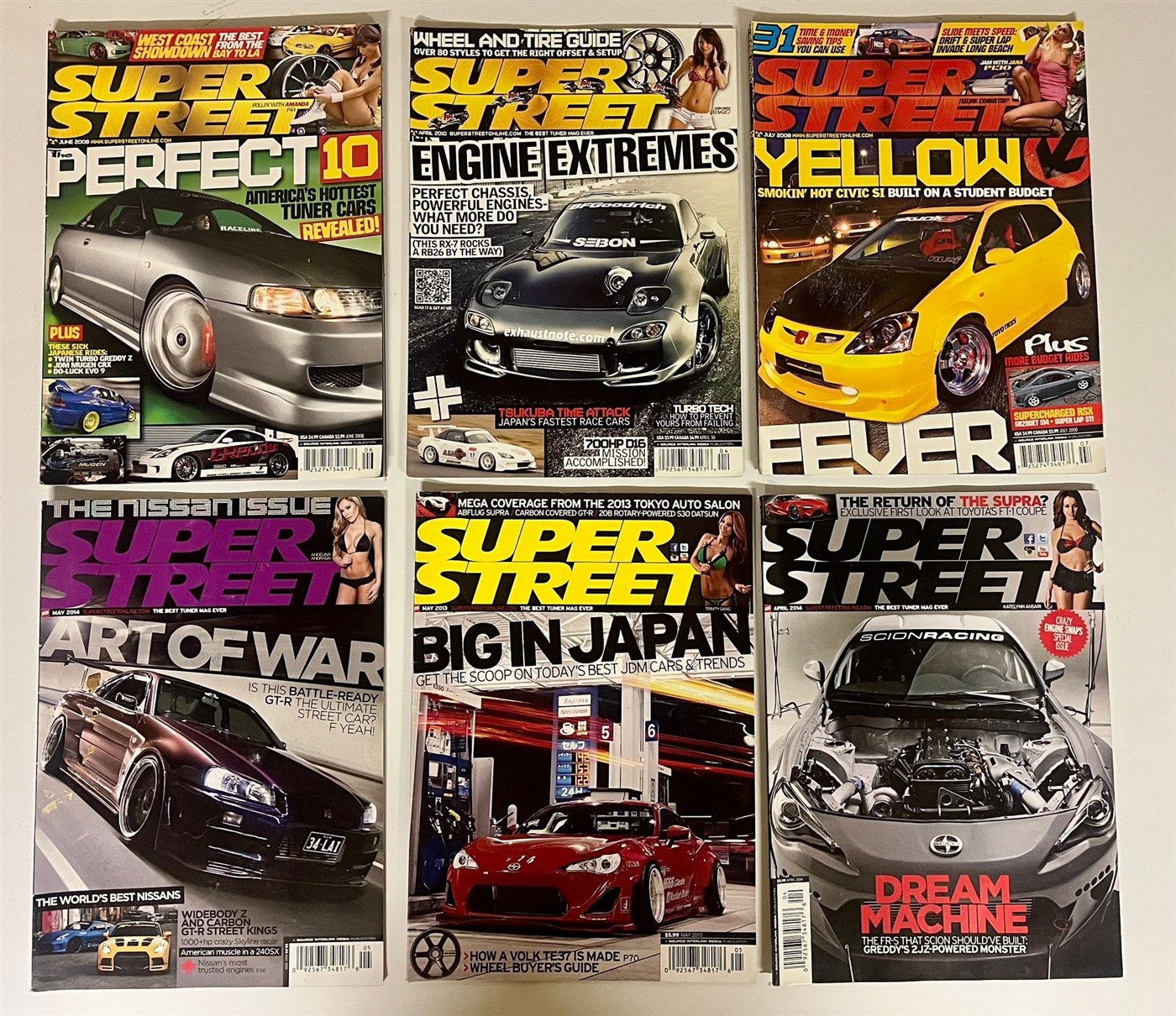
Image supplied by TRACKSET. Magazine covers: Super Street.
If you grew up a car enthusiast in the late 1990s or early 2000s, your love for speed didn't start with an algorithm, a vertical video, or an Instagram drop. It started at the grocery store magazine rack, or at a school desk during homeroom.
Before we ever held a plastic driver’s license, before we had a bank account, and before we even owned a car, we were completely under the spell of print media.
Every month, titles like Super Street, Sport Compact Car, Import Tuner, and Turbo & High-Tech Performance served as the holy scriptures of our subculture. We didn't just read them; we consumed them. We studied the spec sheets like we were preparing for an exam. We carefully tore out the glossy centerfolds of wide-body Toyota Supras and slammed Honda Civics to tape them to our bedroom walls.
The writers of these magazines were our anonymous, chaotic mentors. They taught us the language of boost, offset, and chassis codes before we even knew how to change a tire.
This is the story of the rise, the glorious peak, and the heartbreaking fall of the tuner magazine era—the physical ink that defined our youth.
Part 1: The Magic of the Monthly Drop
In a world before instant internet gratification, information had to be fought for. It had to be curated, photographed on physical film, written on a tight deadline, printed on giant industrial presses, and physically shipped to a store.
When a new issue of Super Street or Import Tuner dropped, it was a legitimate cultural event. The cover art alone was an absolute masterclass in early-2000s design: hyper-saturated candy colors, bold graffiti-style fonts, and angle shots of cars parked in industrial concrete warehouses under harsh strobe lighting.
But the real magic lay in the tone. The automotive journalists who wrote these articles—legends like Dave Coleman, Jonathan Wong, and Nads—didn't write like traditional, stuffy journalists. They wrote like your hilarious older brothers who spent way too much time inhaling exhaust fumes in a garage. They made fun of each other in the editorial notes, told wild stories about driving modified cars across state lines with no air conditioning, and injected a raw, human soul into mechanical reviews.
Part 2: The Canonical Segments We All Memorized
Every magazine followed a strict structural blueprint that we all learned to read like a map.
1. The Spec Box (The Metric of Truth)
Every feature car had a dedicated, text-dense box somewhere on the page listing every single modification done to the vehicle. It was broken down ruthlessly: Engine, Drivetrain, Suspension, Wheels/Tires, Exterior, Interior. We would stare at those boxes for hours, memorizing real-world parts brands like GReddy, HKS, Tein, Skunk2, and Apexi. If a car didn't have a dyno-proven horsepower number listed at the bottom of that box, the build didn't count.
2. The Text-Grid Mail-Order Ads
Halfway through the magazine, the glossy feature stories would stop, and the paper would turn into a rougher, matte finish. This was the marketplace. Pages upon pages of tiny, microscopic text grids from mail-order giants like Options Auto Salon or Group A Motoring. It listed every single aftermarket part available on Earth with its corresponding price tag. We would sit with a highlighter during lunch period, circling the exact cost of an AEM cold air intake or a set of lowering springs for a car we didn’t even own yet.
3. The Technical Deep Dives
Magazines like Sport Compact Car didn't just show off flashy paint jobs; they were deeply educational. Features like the "Ultimate Street Car Challenge" or deep-dive engineering articles broke down the actual physics of suspension geometry, roll centers, and turbocharger compressor maps. They demystified the machine, teaching a generation of teenagers that they didn't need to pay a high-end race shop to build a fast car—they could figure it out themselves with a basic set of tools and some patience.
Part 3: The Digital Eclipse
The end of the print era was slow, then all at once. By the late 2000s and early 2010s, a massive technological wave crashed over the media landscape.
High-speed internet became standard, and along with it came automotive blogs, YouTube channels, and eventually, social media algorithms.
A monthly print magazine simply couldn't compete with the speed of a digital feed. Why wait 30 days to see a photo of a modified Nissan GT-R when you could watch a video of it racing down a highway on your phone in real-time? Advertising dollars rapidly shifted away from print pages to digital ad networks.
One by one, the giants fell. Sport Compact Car folded in 2009. Import Tuner stopped printing in 2014. Super Street—the absolute flagship survival icon of our youth—finally transitioned to an all-digital format before ending its long run entirely. The physical paper world had been completely eclipsed by glass screens.
The Verdict: The Lasting Impression of Physical Ink
The loss of the physical car magazine left a distinct void in the soul of the car community. When you look back at your time reading those magazines in your school’s homeroom, you aren’t just experiencing hollow nostalgia; you are remembering a time when the car community had a unified village square.
Because we all read the exact same magazines every month, we shared a cohesive dictionary of slang, styling, and engineering standards. Print media forced us to slow down, read long-form stories, and respect the sheer time it took to build something worthy of a camera lens.
The magazines may be gone, and our old bedroom walls may be painted over, but the blueprint they printed on our brains is permanent. Every time you walk up to a car meet and appreciate a clean engine bay, every time you recognize a high-end wheel brand from fifty feet away, and every time you look past a flashy wrap to inspect the actual mechanical craftsmanship underneath—you are carrying on the legacy of the glossy pages that taught us how to dream.


COMMENTS